
Turn existing APIs into
governed AI tools
in under 5 minutes.
Give agents capability, not credentials.
KeyRunner is the governed execution layer for enterprise AI agents. Connect an existing API, add the KeyRunner SDK, onboard your agent, and run governed actions with policy enforcement, runtime secret injection, approvals, redaction, and auditability built in.
KeyRunner converts enterprise APIs into governed AI tools. Connect your API, add the SDK, onboard your agent, and run governed actions with policy enforcement, secret injection, and full audit trails.
How it works
Connect API
Import OpenAPI spec in seconds
Add SDK
A few lines of code
Onboard agent
Give agent approved tools
Run governed
Safe, monitored, auditable
Agent requests an API action
Your API / Enterprise Systems
No secrets exposed to the model
Credentials are never stored or shared with the LLM.
Sensitive data redacted
Responses are filtered before they reach the agent.
Policy checked before every action
Only allowed actions with valid inputs are executed.
High-risk writes require approval
Critical actions get human approval when needed.
Every execution is auditable
Complete logs for every action, decision, and user.




Why agents fail in production
Most API-connected agents never make it past the demo.
They all hit the same three walls.
Agents get too close to raw credentials
Internal API workflows often require tokens, service accounts, OAuth grants, or environment secrets. When agents, scripts, or MCP tools handle them directly, credentials can leak into logs, traces, prompts, local files, or overly broad runtimes.
Logs show what happened. They do not stop it.
Post-execution logs help with investigation, but they do not enforce policy before a risky API call goes out. Production agents need pre-execution checks for user, agent, action, environment, and payload.
Every new agent rebuilds the same API actions
Teams wire the same Stripe, Slack, Salesforce, GitHub, cloud, and internal APIs into Claude, Cursor, ChatGPT, scripts, and internal agents. Without a shared governed runtime, API logic drifts and risk multiplies.
The fix
One API workflow layer. Every agent governed.
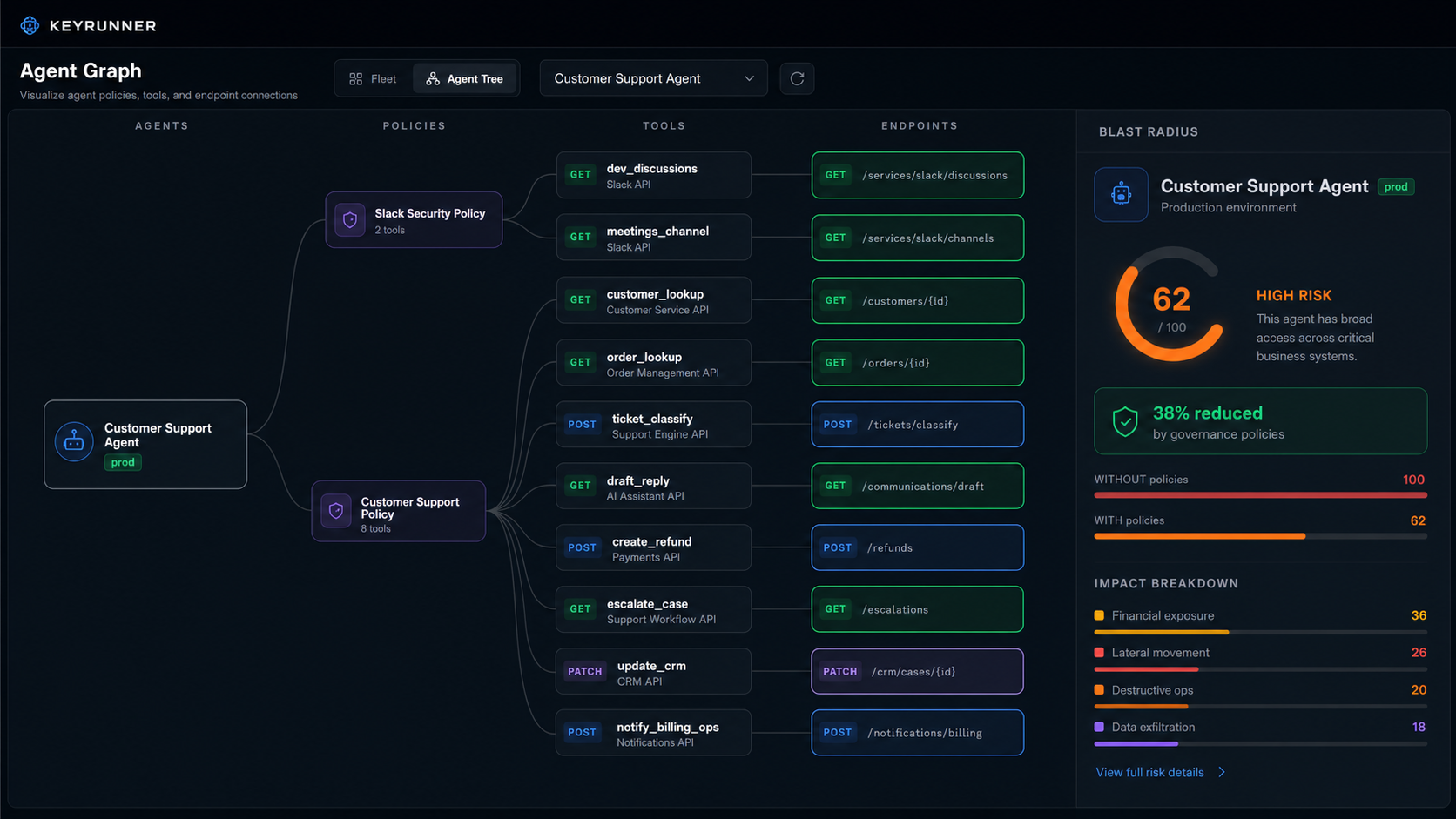
KeyRunner starts as the API client your team uses to build and test requests. Those requests become reusable workflows, and those workflows become approved actions agents can run with policy, runtime credentials, redaction, and audit built in.
See how it worksUniversal coverage
Any agent. Any API.
KeyRunner sits in the middle. Agents never touch credentials. APIs never send raw data to your model.
Any agent
Named action
no credentials passed
Clean response
agent-safe data only
KeyRunner
governed runtime
On every request
On every response
Credential sources
Fetched at runtime. Never stored by KeyRunner.
Auth'd API call
credentials injected
Raw response
unredacted, all fields
Any API or app
See how KeyRunner works
From OpenAPI spec to governed agent tool in five steps. Credentials stay in your vault. PII never reaches the agent.
Import your API
Paste an OpenAPI spec. KeyRunner converts every endpoint into a named, governed tool — no changes to the downstream service.
API client for developers.
Governance layer for agents.
The same APIs you test with the client become governed tools your AI agents call through the enforcement layer.
Why trust us?
KeyRunner is built to give security, platform, and developer teams a tighter execution model without slowing down daily work.
Security controls built into the workflow
KeyRunner is designed to protect execution paths, secrets, and tenant boundaries from the start.
Zero Trust Framework
Every request is authenticated and verified to reduce unauthorized access risk.
Encrypted Environment Variables
Sensitive configuration stays protected with stronger handling for runtime secrets.
Centralized KeyConnector
Enterprise requests can be routed through infrastructure that runs inside your environment.
Safer handling for sensitive information
KeyRunner reduces accidental exposure with controls focused on what developers actually send and receive.
Sensitive Data Redaction
PII, PHI, and PCI can be redacted according to tenant-defined security rules.
Secrets Scanner
Continuously scan collections and requests to identify risky values before they spread.
Data Anonymization
Anonymize response data when needed to preserve privacy and reduce downstream exposure.
Visibility for security and governance teams
Operational trust is not just about prevention. It also depends on auditability, monitoring, and evidence.
Compliance with Industry Standards
Practices align with major compliance expectations so organizations can move with more confidence.
Audit Trails
Keep detailed records of actions and system behavior for accountability and review.
User Activity Monitoring
Track behavior across the platform to surface operational patterns and potential concerns.
Give agents capability. Not credentials.
Start with the free API client for developers. Add policy enforcement, credential isolation, and audit trails when your agentic workflows need enterprise-grade governance.
Credentials are injected at runtime, inside your infrastructure. Agents invoke named actions, nothing more.